
Tankless water heater services
Tankless Water Heater Services for Elizabethtown, KY Homes: Check Gas, Power and Venting First
On-demand heating changes what a house has to supply. This page covers the gas, electrical and venting questions, how undersink units differ and what repair visits involve.
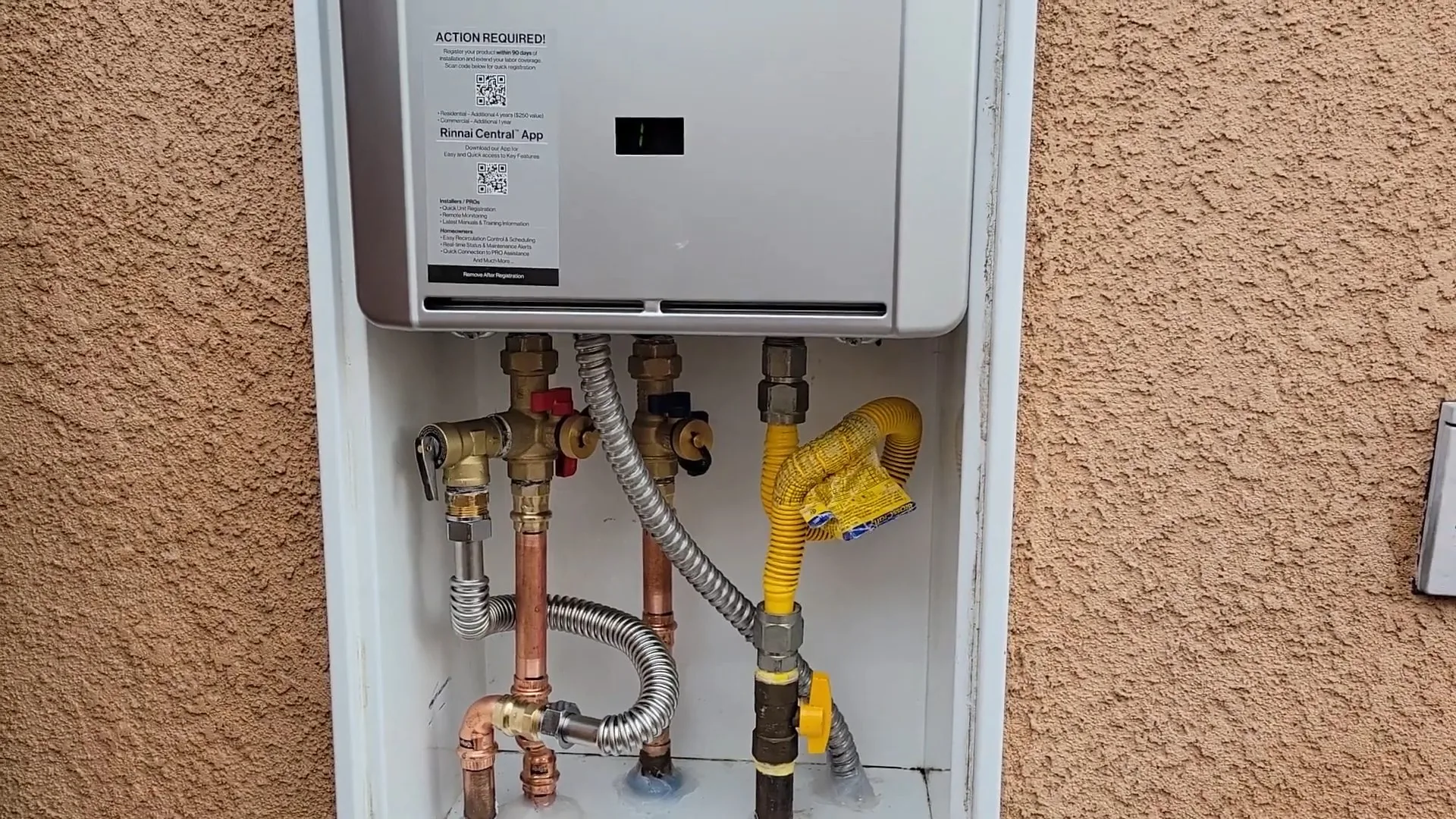
You are considering tankless: the questions that decide whether it fits
A tankless heater warms water as it flows instead of storing it. That changes what the house has to supply: more gas or more electricity at once, a different venting arrangement and a plan for the minerals in the water. Whether it fits depends on the house, not only the household.
- How many fixtures run at the same time during your busiest hour?
- Is there a gas line large enough, or an electrical panel with room?
- Is there a path for the vent?
- Do you want to replace a tank, or add hot water at a single far-off spot?
The answers point to a whole-house unit, a smaller point-of-use unit or a decision to keep a tank.
Whole-house tankless, undersink units and point-of-use heaters
| Unit | What it serves | What to check |
|---|---|---|
| Whole-house gas | Every fixture in the home | Gas line capacity, vent route and condensate drain |
| Whole-house electric | Every fixture, with high electrical demand | Panel space and the size of the circuit |
| Undersink or point-of-use electric | A single sink or a distant bathroom | A nearby outlet or small circuit, and the flow it can deliver |
| Recirculation add-on | Long runs of pipe | Whether the pump and line suit the unit |
A small unit under a sink is a different product from a whole-house heater. It trims the wait for hot water at one tap, and it is not a way to run the shower.
What a tankless install changes: gas, power and venting
Moving to on-demand heating changes the demands on the home. A heater that fires hard for a few minutes needs more input than a tank that heats slowly, and the supporting systems have to match.
- Gas. A larger line or a regulator change may be needed. Ask for the demand figure and the pipe size.
- Electric. Large units draw heavy current. The panel and wiring have to handle it.
- Venting. High-efficiency units use a different vent material and route from a tank.
- Condensate. Some units produce acidic condensate that needs a drain or neutralizer.
Ask who is responsible for each piece. A tankless swap often involves a plumber, an electrician and the gas supplier, and a quote that covers only the unit leaves gaps.
Hot water that arrives late and the cold sandwich
A tankless unit does not make water hot instantly. Two common complaints come from how the system behaves, not from a defect.
- The wait. The unit has to fire up and the pipe between heater and tap has to fill. Distance adds delay.
- The cold sandwich. A short pause in use can send a slug of cold water through the line between two hot bursts.
- Low-flow cutoff. A very low flow may not trigger the unit.
Recirculation and a buffer tank are the usual fixes for the wait. Ask what the quote assumes about distance and whether a recirculation option is included or extra.
Thinking about going tankless?
Call and describe your fixtures, gas or power and where the heater would go.
Minerals, flushing and keeping a tankless unit working
Minerals in the water collect inside the heat exchanger, and a unit that is not flushed will lose output and eventually fail. How fast it happens depends on your water and the settings you use.
- Ask for the maintenance routine in writing, including how often to flush the unit.
- Ask whether the unit has isolation valves, which make flushing practical.
- Ask whether a filter or softener is advisable for your water supply.
- Keep the manual and the model number in one place.
Water suppliers generally publish a water quality report. Ask yours for the latest one rather than assuming what the water contains.
Tankless repair: error codes, no hot water and cold-water complaints
Tankless units display codes when something goes wrong. A code points the plumber to a system, but it does not name the failed part.
- A code about ignition, flame or gas supply points to the fuel side.
- A code about overheating or flow often points to scale or a blocked inlet filter.
- A unit that shuts off when a second tap opens may be undersized or restricted.
- A condensate or vent code needs attention before the unit is used again.
Note the code, the model and what you were doing when it appeared. Photograph the display. Tankless repair is a different job from fixing a tank-style heater.
Is tankless right for this house? A plain comparison
| Question | Tank | Tankless |
|---|---|---|
| Hot water for several fixtures at once | Limited by tank size and recovery | Limited by the flow rate of the unit |
| Space | Needs a spot for the tank | Wall-mounted, smaller footprint |
| Home changes needed | Often a like-for-like swap | Often gas, power or vent upgrades |
| Maintenance | Flush and check the valves | Flush the heat exchanger on a schedule |
| If you are replacing a failed tank | See installing a new tank | This page |
Neither type wins for every home. The better choice is the one the house can support and the household will notice.
Retrofitting a house that was built for a tank
Most homes in town were plumbed and wired for a storage tank. Swapping to on-demand means fitting new demands into an old layout, and the surprises tend to come from the gas line, the vent path and the panel.
- A gas meter or line sized for a tank may not deliver enough for an on-demand unit firing at full rate.
- A chimney used by the old gas tank may not be suitable for the new vent, and the old flue may need to be addressed.
- A panel with no spare capacity can turn an electric unit into an electrical upgrade.
- A tight closet may leave no clearance for the unit or its service access.
Ask for a site visit before a quote. A price given over the phone for a tankless swap cannot account for what is behind the wall.